


As an elite runner who thrives in solitude, I’ve learned that not every race is measured in miles — some are run within the mind.
What began as a way to sharpen endurance gradually evolved into something far quieter and deeper: a running meditation.
In the early days, competition was everything. I chased times, splits, and finish lines as if they defined my worth.
But over the years, I discovered that the most meaningful victories didn’t happen on the podium — they happened in the quiet miles when no one was watching. That’s when I began to understand what running for mental clarity truly meant.
When I run alone, there’s no audience, no comparison — just rhythm, breath, and silence weaving together into awareness.
The steady sound of my footsteps becomes a mantra, syncing with the rise and fall of my breath until thought itself begins to thin out. That’s when I find it — that rare, elusive stillness no amount of sitting still could give me.
In a world obsessed with noise and measurement, solitude on the road has become my quiet rebellion.
“Sometimes clarity isn’t found by thinking — it’s found in moving meditation.” — from Running for Mental Clarity.
When Solitude Becomes Sacred Space
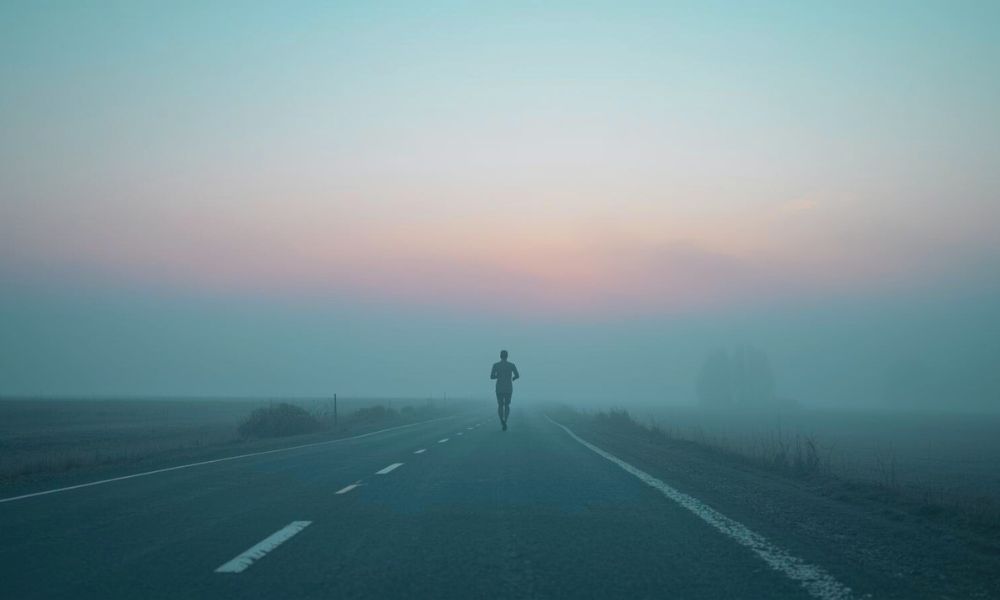
There’s a holiness in the quiet miles — a kind of chapel built from rhythm and breath. When I’m out there alone, the world narrows to the sound of my shoes and the pulse in my chest.
No small talk, no chatter — just running and solitude, stripped to its purest form.
People often ask if I ever get lonely training this way. I used to. I once filled every run with music or distraction, afraid of silence.
But the more I leaned into solitude, the more I discovered the hidden benefit of running alone: it isn’t isolation — it’s immersion. Every solo run becomes a conversation with the self, a chance to listen without interruption.
I remember one dawn run — the streets still asleep, the air cool and damp. I could hear my breath, my footsteps, even my heartbeat echoing through the stillness.
That morning, I realized I wasn’t alone at all. Solitude was simply presence — the space where the world’s noise fades and something deeper begins to speak.
In those silent stretches of road, subtler things emerge: the rhythm of breath shifting with terrain, the hum of energy rising in the body, the quiet knowing that peace doesn’t come from company — it comes from attention.
Solitude teaches you to face yourself without flinching. Once you make peace with that, every run becomes a sacred retreat — not away from the world, but toward the center of it.
“In solitude we find not loneliness, but connection.” — from How Running Helped Me Accept Solitude.
The Rhythm of Breath and Step
Every solo run begins with sound — the quiet metronome of breath and step, breath and step. When both align, the mind starts to quiet.
What was once effort turns into flow, and movement becomes awareness. That’s the essence of moving meditation running — a space where discipline meets stillness.
I often focus on my breathing rhythm — four steps in, four steps out — until I feel the mind settle behind the breath. It’s not about control; it’s about letting the body lead and the mind follow. The repetition becomes a mantra, the road a teacher.
As I run, I tune into tiny details: the soft hiss of air leaving my lungs, the brush of wind against my arms, the subtle shift in muscle tension. Each cue anchors me deeper into presence. It’s a living meditation — awareness that moves.
In those moments, I’m no longer doing mindful running — I’m simply being in it. The miles unfold like deep breaths, and every exhale feels like a small release of tension I didn’t know I was carrying.
As Eliud Kipchoge once said, “Only the disciplined ones in life are free.”
On the road, I finally understood what he meant — freedom isn’t found in stillness or silence alone, but in rhythm. The rhythm that carries you beyond thought, beyond struggle, into something wordless and alive.
When the Mind Finally Lets Go
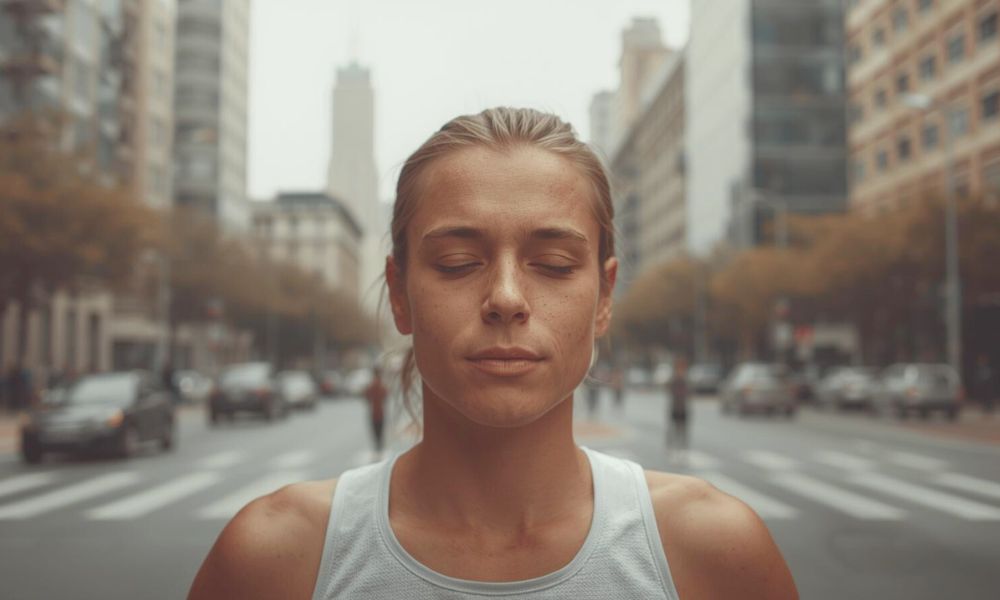
In the beginning, the mind resists. Thoughts rush in like spectators — unfinished tasks, stray worries, yesterday’s noise. But as the miles unfold, something shifts.
The chaos stretches, softens, and eventually dissolves into the background hum of breath. That’s when the run transforms from movement to meditation in motion.
There’s a moment on every long run when silence stops feeling empty and starts feeling full — full of rhythm, of life happening exactly as it should.
This is running in silence — not the absence of sound, but the presence of attention.
I once believed mindfulness required stillness: sitting, breathing, clearing the mind. But running taught me that awareness doesn’t depend on being still.
The road can be as meditative as the cushion. The heart may pound, sweat may pour, yet the mind remains calm at the center of it all.
In that space, I no longer chase pace or distance. I simply run — fully awake, fully here. Every inhale is an arrival; every exhale, a letting go.
As Jon Kabat-Zinn wrote, “You can’t stop the waves, but you can learn to surf.”
Running taught me not to silence the mind, but to ride its rhythm until thought and motion become one seamless flow.
Running as a Mirror of the Mind
Some days, the run flows; other days, it fights back. Each step reflects what’s inside me. When the road feels heavy, I know I’m carrying something unseen — worry, ego, resistance.
That’s where running as therapy begins: not in fixing the mind, but in watching it honestly.
Every mile is a mirror. It shows how I respond to discomfort, how quickly I judge myself, and how easily I surrender.
The solitude of running doesn’t hide these truths — it reveals them. Once you face what surfaces, the road stops being a test and becomes a teacher.
Some mornings, anger fuels the first few miles; by the tenth, it dissolves into acceptance. Other times, I start tired and end renewed, realizing fatigue was mostly in my head.
Running has become my mirror — reflecting moods, habits, fears — then softening them in motion. It also changed my life.
There’s a quiet reward that follows this confrontation — a stillness born of surrender. The more I stop fighting the mind, the clearer it becomes. It’s the paradox of running: the faster the body moves, the quieter the thoughts become.
As Haruki Murakami wrote, “Pain is inevitable. Suffering is optional.”
Running doesn’t erase pain — it reframes it. It teaches that peace isn’t found in avoiding difficulty, but in moving through it with awareness.
Carrying the Calm Beyond the Run
When the run ends, the stillness doesn’t. It lingers — in the pause before speaking, in the calm between tasks, in noticing small things again.
What starts as running for inner peace eventually becomes living with quieter awareness.
That rhythm learned on the road follows me into the rest of my life. When stress builds, I breathe as I do on the run: steady, grounded, patient.
When noise crowds in, I recall the discipline of silence — the same silence that once felt foreign but now feels sacred.
Sometimes I’ll cool down at sunrise — the city still half-asleep, the sky shifting colors. The world feels larger, yet gentler.
In that quiet glow, I realize the run was never about distance — it was about depth. Each stride is another lesson in being fully here.
Running has taught me that peace isn’t something found only when we stop moving. Sometimes, it’s the motion itself that delivers it — breath, rhythm, solitude, all working as one.
In a world that constantly demands attention, solo running becomes an act of quiet rebellion — a return to presence. Every stride is a reminder: clarity doesn’t come from escaping the world, but from returning to yourself — one mindful step at a time.
Final Thoughts
In many ways, the quiet awareness you find in a running meditation becomes the foundation of something deeper — emotional strength. When you learn to stay present through breath and motion, you’re also learning resilience.
Each mindful mile teaches you how to face discomfort with calm and return to yourself when life feels heavy.
That’s the quiet thread explored further in Running Emotional Resilience: Lessons From Solitude and Stillness — how solitude and stillness on the run shape not just the mind, but the heart.