

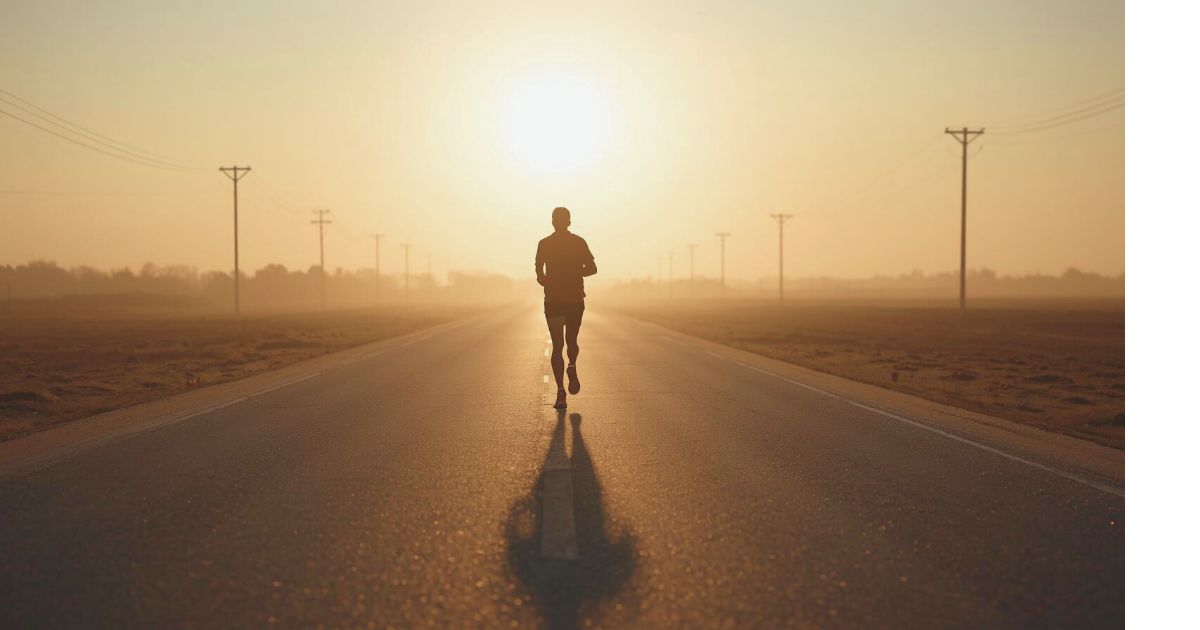
The street is still asleep. A faint orange glow leaks through the horizon as you tighten your laces, feeling that small, familiar pull between comfort and discipline. The world hasn’t woken yet — only the soft hum of your breath and the echo of your footsteps.
This is where the benefits of running alone begin to unfold — in the quiet moments when it’s just you, your thoughts, and the steady rhythm that no one else can hear.
Out here, it’s just you and the road. No music, no crowd, no need to prove anything. Just motion — steady, patient, honest.
Somewhere in your 40s, running alone starts to mean more than fitness. It becomes a way to think, to heal, to find quiet in a world that keeps getting louder.
And the deeper you go into those silent miles, the more you realize — this isn’t just running anymore. It’s rediscovery.
6 Mental Benefits of Running Alone
When you start running alone, the first thing that changes isn’t your pace — it’s your headspace. In the hush of early morning or the steady hum of a treadmill, the mental benefits of running alone begin to unfold.
Each stride becomes less about fitness and more about focus, balance, and the quiet rebuilding of your inner world.
1. Freedom from Comparison
Solo running removes the scoreboard that lives in your mind. There’s no one to outpace, no app ranking, no quiet guilt about being slower than last week. You run because you want to, not because you have to.
In that freedom, you start hearing your own rhythm again — steady, unhurried, deeply personal. It’s a small but powerful reminder that progress doesn’t need witnesses to be real.
2. Space to Think and Feel
Life in your 40s can feel like a never-ending checklist — work, family, finances, the weight of what’s next. But when you run alone, those thoughts start to stretch out and breathe. Problems untangle, ideas form, and emotions you’ve been suppressing finally surface.
It’s therapy in motion. As I wrote in How Running Helped Me Accept Solitude, there’s a moment when being alone stops feeling like emptiness and starts feeling like healing.
3. The Power of Presence
Running alone sharpens awareness in ways group runs rarely do. You feel the texture of the ground, hear your breathing, and notice how your body subtly adjusts with every stride.
It’s mindful running — learning to stay anchored in the present instead of getting lost in past mistakes or future worries. Over time, this habit spills into daily life, helping you stay calmer and more centered when everything else feels rushed.
4. Building Emotional Resilience
When no one is there to push you, you become your own motivator. Facing a tough run alone trains the same muscle as facing a hard day: persistence.
You learn to keep going without applause, to draw strength from consistency instead of validation. That quiet resilience — the kind built mile after mile — lasts far longer than physical stamina.
5. Reconnection with Purpose
In your 40s, it’s easy to drift into autopilot. Responsibilities blur the reasons behind what you do. But solitary runs create a pause — a small, sacred space to ask why. Why am I doing this?
What still matters to me?
With each mile, answers surface in fragments: gratitude, pride, a sense of purpose that can’t be measured by pace or medals. Running alone helps you remember that you’re not running away from life — you’re running deeper into it.
6. Emotional Reset and Stress Relief
Stress doesn’t disappear when you ignore it; it settles in your body. Running alone gives it a way out. The rhythm of movement, the controlled breathing, the steady heart rate — they act like a mental rinse, flushing tension and replacing it with calm.
The science calls it endorphins and serotonin; runners simply call it peace. Afterward, you return to the world lighter, clearer, a little more yourself again.
Running alone is more than an act of endurance. It’s a dialogue with your thoughts, a meditation in motion, and a quiet promise to keep showing up for yourself — no matter who else is watching.
Read how running has changed my life.
Should You Run with Music, Podcasts, or in Silence?
Every runner has a soundtrack.
For some, it’s a high-tempo playlist that fuels every stride. For others, it’s a podcast that turns an easy run into a moving classroom. But for introverted runners, there’s a third option — silence — and it’s often the most powerful one.
When you run in silence, you begin to hear things you normally miss: the rhythm of your breath, the soft cadence of your footsteps, the steady beat of your heart. These sounds become your companions — reminders that you’re alive, moving, and present.
Silence turns running into a form of meditation.
Without external noise, your mind clears. Thoughts surface and fade. You start noticing your emotions, your fatigue, your motivation — not as distractions, but as signals. This is where solitude becomes self-awareness.
That’s not to say music or podcasts are wrong. Each has its place:
- Music can lift your mood or push you through tough intervals.
- Podcasts can educate or distract on long, easy runs.
- Silence helps you reconnect with yourself and find clarity.
The key is intentional choice. Ask yourself what you need from today’s run — energy, escape, or peace. Then tune in (or tune out) accordingly.
Because sometimes, the most meaningful miles are the ones where the only sound you hear… is your own breathing.
5 Physical Benefits of Running Alone

Once your mind finds calm in solitude, your body quietly follows. The stillness that clears your head also sharpens how you move.
That’s the real beauty behind the physical benefits of running alone — when the world fades, you finally hear what your body’s been trying to tell you all along.
1. Mastering Your Own Pace
You don’t have to run six miles per hour just because someone else does. When you’re alone, there’s no silent competition, no pressure to match anyone’s pace. You run by feel — letting your breathing set the rhythm, not your watch.
Some days you’re strong and steady at a 10-minute mile; other days you ease back to 12. It doesn’t matter. You’re building endurance, not ego.
Over time, your body learns its natural cruising speed — the one that carries you further, not faster. That’s how stamina quietly grows.
2. Better Body Awareness
Without the chatter of group runs or the distraction of music, you start to hear your body more clearly. The way your right foot lands is a touch heavier than your left. How your shoulders rise when you’re tense.
You adjust mid-run — a posture tweak here, a deeper breath there — and it changes everything. Running alone turns every session into feedback: listen, respond, adapt. That awareness helps prevent injury and keeps your stride smooth, efficient, and uniquely yours.
3. Strength Through Consistency
It’s easy to show up when someone’s waiting at the trailhead. Harder when it’s just you, your shoes, and an empty road. But those solo runs — the ones no one sees — are where real strength builds. Not just in your legs or lungs, but in discipline.
As marathon legend Eliud Kipchoge once said, “Only the disciplined ones are free.”
Running alone teaches you that kind of freedom — the kind earned through repetition, patience, and quiet determination. Each time you show up without needing validation, you prove to yourself that consistency is its own kind of victory.
4. Recovery and Adaptation
Running alone lets you tune into your energy instead of your plan. Maybe today’s a recovery jog, maybe it’s a stride-out kind of day. That’s not inconsistency; that’s awareness.
It’s how your body learns to adapt and recover — through patience, not punishment. Solo running helps you find balance between effort and ease, building longevity instead of burnout.
5. Aging Gracefully Through Movement
By the time you reach your 40s, you realize it’s not about running faster — it’s about running longer. Running alone gives you the freedom to focus on how you feel, not how fast you finish.
You start valuing good form, steady breathing, relaxed posture, and full recovery. Your heart grows stronger, your joints stay happier, and your confidence rises — not from PRs, but from consistency.
You move with respect for your body, and somehow that makes you feel younger with every mile.
The Emotional and Spiritual Side of Running Alone

At some point, every runner realizes that running isn’t just physical. You start a run to move your body, but somewhere between the first and last mile, something softer takes over.
The rhythm of your breath, the quiet repetition of your steps — it all begins to feel like a form of prayer.
That’s where the emotional and spiritual side of running alone quietly begins.
Sometimes the deepest growth happens when you’re running without an audience — when every step is for yourself, not for approval, and the silence becomes your strongest companion.
1. Finding Peace in Motion
There’s a calm that comes after the first few miles — once the stiffness fades and your breathing evens out. The run becomes smoother, quieter, almost meditative. Each step syncs with your heartbeat, and for a few fleeting moments, you’re completely present.
No past to regret, no future to worry about. Just movement and breath. It’s mindfulness in motion — what some call a runner’s high, but to me, it feels more like peace finding its way back in.
2. Solitude as Healing
There were times I ran to escape — from work stress, from noise, from thoughts that wouldn’t quiet down. But running alone slowly changed that. The solitude I once avoided became the space where I started to feel whole again.
When it’s just you and the road, the mind eventually softens. You start listening — not to music, but to what you’ve been carrying inside. You process things. You forgive. You let go.
Solitude stops feeling heavy and starts feeling like recovery — the quiet work of becoming okay again.
3. Rediscovering Gratitude
In my 40s, I’ve come to appreciate each run differently. It’s not about pace anymore — it’s about presence. Some mornings, as the sky lightens and the air feels cool against my skin, I’m simply grateful I can run.
Grateful for a body that still moves, for lungs that still work, for a heart that still answers when called. Gratitude used to be something I tried to practice. Now, it just shows up naturally somewhere around mile four.
4. The Runner’s Faith
I’m not talking about religion, but something quieter — a kind of faith that forms when you’ve spent enough time alone on the road.
Running teaches you to trust the unseen: that the next mile will come, that the pain will pass, that the body knows what to do if you just keep moving.
There’s something sacred about that. Each solo run feels like a small pilgrimage — not to a finish line, but to a better version of yourself. Nature becomes your cathedral, the steady rhythm of your shoes your prayer.
5. Letting Go and Becoming
There’s always a point in the long run when thinking stops. The body moves on instinct; the mind drifts somewhere beyond time. It’s in that quiet blur that everything — stress, doubt, the need to control — starts to dissolve.
You’re no longer running for pace or distance. You’re just running. You feel free, light, human again. When you finish, you’re not the same person who started — just a little clearer, a little calmer, a little more you.
6 Practical Tips to Enjoy Running Alone

Running alone can be both freeing and intimidating. The silence that feels peaceful one day can feel heavy the next. But once you learn how to run with solitude — not against it — everything changes.
These aren’t hard rules, just lessons shaped by quiet miles.
Whether you run outdoors or on a treadmill, these practices help transform solo runs from something you endure into something you look forward to — a ritual that restores you.
1. Start Small, Stay Consistent
Don’t wait for the perfect plan or the right distance. Start with what feels manageable — maybe two miles, maybe twenty minutes. The goal isn’t to conquer distance; it’s to create rhythm.
Solo running rewards consistency, not intensity.
When you start small, you remove the pressure and make space for enjoyment. A short, calm run three times a week does more for your body and mind than one ambitious effort that leaves you burned out.
The magic is in showing up — even on the days when motivation is thin. Each run builds a quiet foundation of trust between you and your body. Over time, those short runs stack up into something bigger than you expected.
2. Create a Safe and Comfortable Environment
Solitude works best when you feel safe. Choose routes you know well — places where you can relax, not glance over your shoulder. If you run on a treadmill, make your space pleasant: adjust the lighting, use a fan, keep water nearby, maybe a small towel.
You don’t need to drown the silence with loud music unless you want to. Sometimes, a low-volume podcast, soft playlist, or even the rhythmic sound of your own footsteps is enough.
Safety brings comfort, and comfort brings consistency. The more at ease you feel, the more your runs start to feel like home — a private place where you can think, breathe, and be.
3. Run by Feel, Not Numbers
You don’t have to chase the numbers on your watch. You don’t have to hit a perfect eight-minute mile, or even maintain the same pace every day.
When you run alone, try to leave your ego behind with your shoes at the door. Run by effort, not expectation. If your breathing feels easy and steady, you’re doing it right. If you need to slow down, that’s fine too.
The body has its own language — heart rate, breath, stride — and when you stop measuring everything, you begin to understand it more clearly. Running by feel turns every session into a conversation rather than a competition.
4. Learn to Listen — Body and Mind
Running alone sharpens awareness. You start to notice small cues: a twinge in your knee, a tight hamstring, or fatigue that doesn’t fade after the first mile. That’s your body talking.
Listening isn’t a weakness; it’s wisdom. Adjust, stretch, or rest when needed. The same goes for the mind. If a run feels emotionally heavy, slow down. If you’re anxious, focus on your breath — inhale calm, exhale clutter.
Solo running gives you space to listen deeply — not just to your body, but to your thoughts. That awareness doesn’t just make you a better runner; it makes you a better version of yourself.
5. Make Solitude Enjoyable
There’s a difference between being alone and feeling lonely. The key is how you frame it. Try seeing solitude as freedom — freedom to set your own pace, to decide when to stop, to run without pressure.
Some runners enjoy the silence; others bring along soft music or use the time to think, pray, or plan. Find what calms your mind. Running alone becomes easier when you treat it like self-care, not a chore.
The truth is, solitude becomes enjoyable when you stop fighting it. When you learn to welcome your own company, the quiet becomes your best running partner.
6. Reflect After Every Run
When you finish, don’t rush to move on. Take a moment to stretch, breathe, or simply stand still. Notice how your heart slows down, how your body feels alive.
If you can, jot a few words in a journal — not about pace or distance, but how you felt. Did you find clarity? Did you struggle? Did something shift inside you?
Reflection turns your runs into stories — a quiet archive of progress, peace, and persistence. Over time, you’ll look back and realize how much you’ve grown, not just in miles, but in understanding yourself.
Let Solitude Be Your Training Partner
Running alone teaches you more than any finish line ever could. It teaches patience — the kind that comes from steady breathing and slow progress. It teaches humility — the acceptance that some days you’ll glide and some days you’ll struggle.
And most of all, it teaches presence — how to live fully inside a single moment, one footfall at a time.
The miles you run in silence are never wasted. They’re quiet investments — in mental clarity, in physical strength, in emotional balance. They remind you that growth doesn’t need applause, and peace doesn’t need noise.
When you strip away the distractions — the comparisons, the paces, the need to prove — what’s left is something pure. Just movement. Just breathe. Just you.
So let solitude be your training partner. Trust that the stillness has something to teach you. Every run becomes a small act of becoming — not faster, not better, just more you.
And maybe that’s the greatest benefit of running alone: realizing that in your own quiet way, you were never really running alone at all.